Showing posts with label Misc.. Show all posts

Wednesday, September 29, 2010

Cutting God: Saying Goodbye to Sally Menke


Few things in life are fair, but some things are so unfair they make you stop and wonder what the fucking point of getting up in the morning and going through the daily grind is. That's the state that the news of the death of Sally Menke, Quentin Tarantino's career long editor, has left me in. As most of you have probably noticed, I tend to avoid obituaries on this blog, for several reasons, but the primary reasons are A) Whenever anyone dies many movie blogs all chime in with their remembrances, most of which are more eloquent than I am capable of and B) Obituaries of people who worked in the movie industry tend to favor the work over the person, which annoys me. I'm not sad that Sally Menke isn't ever going to edit another movie again - well, I am, but that seems almost beside the point now - I'm sad that she isn't walking amongst us anymore. I'm sad that a director I value very much has lost a collaborator and a friend. I'm sad that her dog, who was with her on her ill-fated hiking trip, has lost an owner and companion. I'm sad for her friends who spent all of Monday worrying about her only to find out in the early hours of Tuesday morning that she was dead. I'm sad for her husband, her two kids, for anyone who was lucky enough to meet her.

And, yes, I'm sad about all the footage that will be shot by Quentin Tarantino throughout the rest of his career that will be unedited by her. I recall in a documentary I saw, that I can't exactly place now, where he said he always felt that he needed a woman to edit his pictures (which I think illuminates part of why he puts women on pedestals in his films, but I digress), his reasoning being that while a man would try to imprint his own ideas for what the film should be in the editing process, a woman would be more nurturing towards his vision. The way I paraphrased it makes it come off a little sexist, but I think the sentiment illuminates a lot about Menke as an artist - that she would listen to Tarantino and do everything within her considerable power to help him make the film he wanted to make. It seems that the two of them were on the same wavelength, and his work to this point has relied on her considerable abilities (he has even flat out stated that he considers her work vital to his own). He also said in that same documentary that cinema is like music, and cutting at the right vs. wrong instant is the cinematic equivalent of a sweet note vs. a sour note; Sally Menke prevented him from playing sour notes. He had such fondness for her that he would always have his actors do a "Hi Sally" take where they would look directly into the camera and say hello to his dear editor. Watching these outtakes now, some of which are available as extra features on his DVDs and on YouTube, is literally heartbreaking.

The only Sally Menke I ever knew was the professional Sally Menke, which was admittedly a distinct pleasure in its own right. It's hard to pick a favorite moment, but there are many unforgettable moments in Tarantino's films that result from her spectacular sense of cinematic rhythm: the final sequence of Reservoir Dogs, as intense as any moment in any movie you can think of; the dance sequence in Pulp Fiction, masterfully cut in time to "You Never Can Tell"; the genius mall sequence at the end of Jackie Brown, which creates a flawless unity of time and place; the fight with the Crazy 88's in Kill Bill, which is lightning fast yet never disorienting; the car chase that serves as the climax of Death Proof, which is visceral yet never sacrifices spacial continuity for cheap thrills; the unforgettable opening of Inglorious Basterds, where the tension builds slowly, deliberately, and when the violence explodes you can almost feel the bullets penetrating your flesh. All these moments belong to Menke as much as they belong to Tarantino.

For all these unforgettable moments, and many others, I will forever be thankful to Sally Menke. I will miss her as much as you can possibly miss someone you've never met. Rest in peace.

Saturday, July 17, 2010

My Blu Heaven

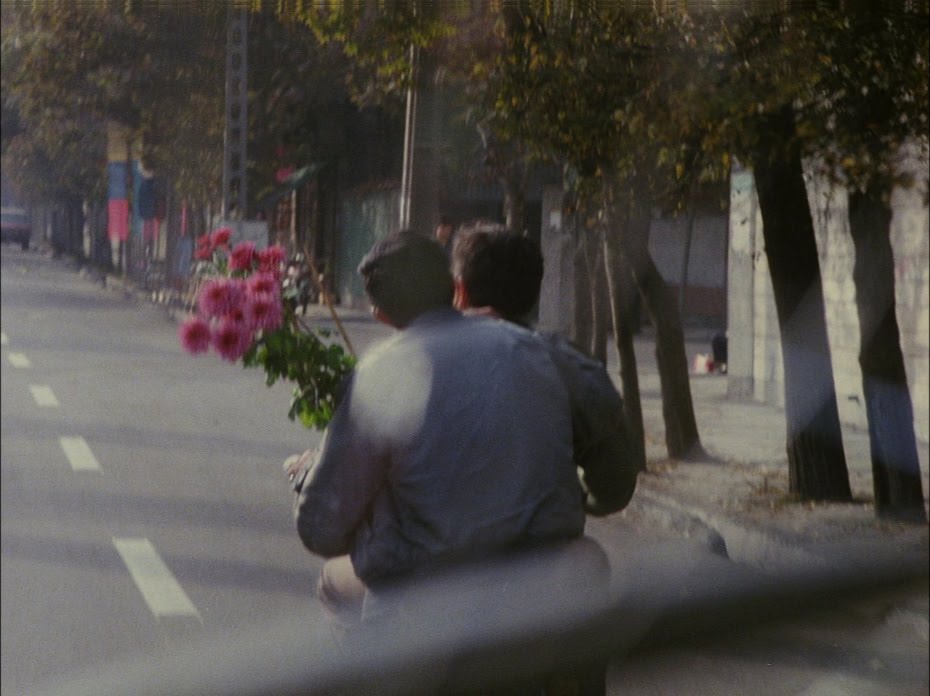
Screenshot unceremoniously ripped from the indispensable DVD Beaver.

So, about a week ago I decided it was high time for me to join 21st Century - or at least the late 00s - and get myself a Blu-ray player. Now that I finally bought the damn thing, I can't believe it took me so long to get one, but hey, times are hard, and the almighty dollar can sometimes prevent us from indulging in the things we would like to. But, while surfing a certain internet based wholesale retailer, I found one for a reasonable price and threw caution to the wind. The time has come!

It's not everyday that the complexion of your movie watching experience is so radically upgraded, so I, being a sad sap and all, had to make a big production out of what my first purchase would be. I eventually decided on Kiarostami's transcendent masterpiece Close Up, and my reasoning was, believe it or not, two-fold. First, I'd never even seen Criterion's standard edition of it, nor the print that was recently exhibited at Manhattan's Film Forum, in spite of Close Up being a favorite of mine. The only edition I'd seen of it before my most recent viewing of it on Blu-ray was the old Facets DVD of it which, if you've never seen it, consider yourself lucky; the colors are washed out and faded, the image is blurry, and the trial footage is a notch above unwatchable (if that). A film as great as Close Up deserves the immaculate treatment, and seeing this stunning BD of it amounted to essentially seeing it for the first time (seriously, what the folks at Criterion do is art unto itself).

What made my selection all the more fitting is that Close Up is a film that attempts to show us what it means to see and hear - it's perhaps Kiarostami's most fully realized investigation into the nature of form, a rumination on narrative that tears down the barrier separating fiction from nonficiton. Close Up tells the story of a man, Hossain Sabzian, who convinces a family that he is Iranian film maker Mohsen Mahkmalbaf and will make a movie with them. He gets in their good graces, stays in their home, and even takes them to see Mahkmalbaf's The Cyclist, which he tells Kiarostami early in the film (which takes place after he's been arrested) is a part of him - a simultaneously beautiful and disturbing confession. What is upsetting about Sabzian (who died of asthma not long after the events of Close Up, according to Kiarostami) is that he escapes into images, that he sees more beauty in cinema than he does in his own life, and that his love of cinema manifests itself in the most desperate of cries for help. And the auteurs he so revered responded, because Kiarostami understood that Sabzian is Mahkmalbaf. And he's Kiarostami, too.

Though all the individuals involved in the real life case play themselves, calling Close Up expressly a documentary oversimplifies the film a great deal. While Close Up contains footage from Sabzian's trial, it also features reenactments of Sabzian's alleged crime (which surely must have been awkward - how Kiarostami and Mahkmalbaf talked them into it is anyone's guess), which complicates the issue even further. This as well as Kiarostami's next feature Life, And Nothing More integrate fact and fiction in supremely inventive ways, and though both these films are extremely formal, they are also extraordinarily moving depictions of the plight of the poor in Iran. To view Kiarostami expressly as a formalist is to ignore his uniquely sensitive perspective towards class differences, and Hossain Sabzian may be the most fitting vehicle for this radically humanist sentiment, because Sabzian sees more beauty in art and cinema than he does in real life (he's a personification of Trufaut's famous quote, "I have always preferred the reflection of life to life itself") - and Kiarotami realizes that, perhaps if things have gone a little differently in his life, he could have turned out just like Sabzian.

However, Kiarostami's portrait of Sabzian does not reinforce Sabzian's view but rather transcends it in the film's climax, which depicts Sabzian being released from prison and being met by Mahkmalbaf, who sobs when he makes eye contact with him (this meeting was allegedly staged by Kiarostami, though Sabzian's tears are apparently authentic). Kiarostami's camera rests in a van in the distance, observing this unique meeting from afar, though this directorial choice makes the scene feel more intimate, oddly enough. What makes this moment powerful and unforgettable, however, is because the camera crew's microphone that they wired on Sabzian isn't functioning properly (a dramatic contrivance cooked up by Kiarostami after the fact), and though this seems like a bit of a smartass tactic at first, it makes the scene nothing short of heartbreaking, as Kiarostami reminds us that, no matter how powerful something in a movie may be, it's still just image and sound. The sequence of these two men - the real Mahkmalbaf and the bogus Mahkmalbaf - riding through the streets of Tehran on Mahkmalbaf's motorcycle is the perfect expression of the bridge between the imagined and the real that has been a defining element of Kiarostami's career. Kiarostami understands that cinema can offer an escape, but movies are as powerful an art form as they are because they reflect the human experience, not because they distract from it.

Seeing the Criterion Blu-ray was a true revelation, among the most exhilarating cinematic experiences I've had in quite some time. The colors so vibrantly fleshed out - especially stunning are the fading leaves of the trees, the roses purchased in the film's profoundly moving climax, and the green aerosol can that figures into the film's opening (which is the punchline for a great jab at Kiarostami's famously minimalist style - in one moment he imbues the weight of the world in this rolling can, and in another, a character kicks it aside without a second thought) - that it really is like seeing the film for the first time. Though Kiarostami's style is minimalist, he also tells very complex stories visually and that makes every element of his compositions especially vital. None of Kiarostami's films so clearly illustrate this fact, and none of them needed this stunning facelift more (though please, please, please release his masterful Koker Trilogy).

So, yeah, I kinda like this whole Blu-ray thing.

Sunday, January 31, 2010

Anniversary


So, as I sit here at my kitchen counter on this bitter cold Sunday evening, there is a feeling gnawing away at me that this --- this --- is an important day. A monumental day. A historic day. Shit, it's an historic day, because we all know when something really important happens, in the historic sense, you use an instead of a, even though it's not grammatically pertinent. But whatever, gramaturgical (I made that word up) exceptions must be made for important, monumental, historic days like this one.

Yes, you guessed right, on this day 49 years ago, Ham the Chimp became the first almost-human to go into outer space. Here's the cute little guy preparing for his intergalactic adventure:


Also, one year ago today, your humble host was bored on a Saturday night at work and said to himself "Oh, what the hell, I'll throw my hat into the film criticism blogsophere". Three book deals, millions of fans, and 165,203 posts later (approximately), here we are.

I would just like to take this opportunity to extend a hearty thanks to all my readers and fellow film bloggers who have been nothing but kind and welcoming to me over the course of the last year. Even during my long hiatuses (which I most sincerely apologize for, and hope to put a stop to) I've come back to writing and felt like no time has passed at all. That people have responded to my writing and felt compelled to share their thoughts here means more to me than I can express, at least without getting all lame and mushy, and maybe even crying a little, so I'm not even going to try. Just understand that it means a great deal of me, and I hope to be a little more prolific moving in to my second year of blogging.

So, from the bottom of my cold, black heart™: thanks, everybody. You've made blogging fun and rewarding all at once.

Posts of substance forthcoming. I promise.

Wednesday, January 20, 2010

CooCoo for CoCo

The internet firestorm that Lenogate has created is noteworthy to me insofar as it's the first thing that has fired up youth culture since that Obama guy decided he was gonna run for President. O'Brien doesn't merely have supporters, he has partisans, and Leno doesn't have detractors, he has mortal enemies who hate his fucking guts. It's the McCain/Obama dichotomy all over again; the hip, youth centric voice of tomorrow versus the older, decidedly un-hip codger who seems to be out of a different era. And they're both going head-to-head in a battle to claim the highest office in the Television land; the house that Steve Allen, Jack Paar, and Johnny Carson built. Only there's no election, as TV Land is a totalitarian state.

But just look at this "I'm with CoCo" picture, which I find frankly disturbing, and which (not incidentally, I'm sure) resembles the iconic Obama image:


Now, I happen to like O'Brien much more than I like Leno (or Obama, for that matter), but I simply can't get too fired up about this little Late Night fiasco. Frankly, I don't think the time slot suited O'Brien too well. I watched his very first Tonight Show way back in the summer and couldn't help but feel like it wasn't the same O'Brien that I'd been watching all the years prior. Maybe I'd just grown fond of having him in New York, but there was also a kind of anarchy to The Late Show show where, even though obviously everything was scripted, the proceeds felt loose and relaxed. You felt like anything could happen because O'Brien himself was such a burst of spontaneous energy. His Tonight Show, by comparison, felt neutered and safe. The wild, unpredictable energy that I'd always loved about O'Brien was simply absent. And if I had to take a wild stab as to why his show failed, it would be because Conan wasn't Conan enough for the Late Show fans, and the people who'd grown attached to Jay Leno for the 20 or so years that he'd been doing The Tonight Show were put off by the nerdy, quirky, Harvard educated host that had replaced him. For example, O'Brien's mantra when he began preparing his version of The Tonight Show was "What Would Tati Do?" --- Jacques muthafuckin' Tati. Do you think the people who tuned in to watch Leno's middlebrow (to be diplomatic) humor over the years have even the faintest idea who in the hell Jacques Tati is? I suggest that his show is being canned not because NBC is ignoring the will of the people (and they are a private company who has no obligation to the will of the people, anyway), I suggest that it's being canceled because it wasn't very good and failed to find an audience. No great conspiracy.

But I can't help but be amused by this internet campaign and the passionate defense of O'Brien this has brought about. I just want to suggest to all the people signing internet petitions, threatening to picket outside NBC studios, and boycotting NBC networks that this whole ugly situation could have been easily avoided if you'd only watched the show in the first place. If Conan was pulling in the kind of ratings he is now this wouldn't be an issue. Most all of these Conan partisans are people who never bothered to watch his Tonight Show before this week. Yes, kicking O'Brien off the show before it even had a chance to find an audience is Busch League, and putting Leno on in front of him didn't exactly help, but wasn't it also Busch League to kick Leno off his show when it was in first place, strictly to hold on to Conan? NBC took a gamble that simply did not work. O'Brien will be just fine; he will find another show with another network, and perhaps he will be allowed to be himself instead of having to live up to the standard of a (largely imagined) television legacy. And everything will be fine and dandy.

Now, may I suggest we get fired up about something worth getting fired up about, like FILM PRESERVATION?!?!?! Coming soon.

Thursday, December 3, 2009

Growing Up with the Movies


The blogger known by the handle The Kid in the Front Row has instigated a blogathon, which states that the participants recount an experience at the movies that's particularly memorable. Now, I'm much too indecisive to pick just one solitary night at the movies; so many incredible experiences are so ingrained into my psyche that I'd feel bad leaving so many out. So, in chronological order, here are some experiences at the movies that have helped define the person I am today (take that as you will).

We probably all had a time when we started to appreciate movies differently, more substantially, when our understanding of movies become more enriched. If I could draw it to a point, I'd say at the start of High School is when I began to expand my cinematic horizons. I began to watch older movies, foreign movies, or generally anything that was canonized in any way. Due to this, as I got older and older I could feel that my taste was out of sync with those of my peers. Some of them didn't like going on to movies because I would dare be critical of them. Also, when I hit High School, I began to take myself to movies and didn't rely on my parents to drop off and pick up, so going to the movies became less of a special, once in a while thing, and more an ingrained part of my day to day existence. Due to this, from 2002 and onward there are plenty of movies I saw that left a great imprint on me, but this list will only cover pre 2002, thereby reflecting the time in my life when my going to see a movie was a rare occurence --- and the true great experiences were few and far between.

Beauty and the Beast
Circa Christmas 1991

This is the first movie I have clear memories of seeing, and thus it warrants an inclusion on this list regardless of quality. That it happens to be the last watchable, let alone good movie that Disney's hand drawn animation studio made is beside the point, but it certainly doesn't hurt. I was like 3 years old at the time, so my memory is hazy to say the least, but I remember getting very, very upset when Gaston plummets to his death from atop the Beast's castle. I mean, that had to hurt really bad.

Jurassic Park
Circa Summer 1993

Again, I was 4-going-on-5 when I saw this movie, so my memories of it are hazy, but they're more clearly defined than my memories of Beauty and the Beast. This was the first non-Disney, non-animated, non G-rate movie I saw in a movie theater, and I remember being very excited to be seeing something that wasn't expressly 'kiddy'. I remember being scared shitless during the film's claustrophobic, expressionistic opening sequence, being in awe when we got our first glimpse of dinosaur's (the Brontosaurus sequence is quintessential Spielberg --- human beings eclipsed by technology), and then spending the rest of the movie scared shitless when all hell (not to mention carnivores) breaks loose. Most people find the T-Rex sequence to be the scariest and most memorable, but it was the Raptors that had me watching the movie between my fingers --- I had nightmares about being chased by Raptors for years and years afterward. Besides, the T-Rex is basically the hero of the movie, saving our protagonists from certain, painful death (one of the most glorious Deus Ex Machina's in modern movies). Those Raptors, on the other hand, were real bastards.

Every movie lover has that movie: the movie they saw at just the right time in their childhood that will always stick out as being the one that showed them the real power of movies. For me, Jurassic Park is that movie, in that it's the first movie I remember having a visceral, intense reaction to, and for that it will always have a place in my heart.

Toy Story
Circa December 1995

Not many movies have the distinction of being the first of a kind, but Toy Story certainly is that; and a thoroughly charming, clever, and incredibly economic one at that. I remember before we left for the movies, my parents gave me the choice between seeing this and Jumanji, for whatever reason. I chose wisely. Little did I know at the time that I'd seen Disney's swan song, their last truly great contribution to the moving image, nor did I have any conception that Pixar would some day become my mortal enemy. I just loved the movie to death, and still do.

Star Wars (none of this A New Hope shit)
Circa early 1997

I was late to the whole Star Wars party, about 20 years late, to be exact. I hadn't even heard of the movie before I started to see advertisements about the re-release of the so-called special edition of the movie, just in time for its 20th anniversary, and to help build anticipation for the upcoming series of prequels. The experience is memorable for me for many reasons; it's one of the few movies I saw in a theater as a child that actually tapped into a childlike sense of awe, and I went into the theater with virtually no expectations, because I had no idea what this movie was. I loved the movie's sense of adventure, the action, the characters, and it's sense of fun. But this is not the only reason it was memorable; I wanted to sit in the front, because I knew this was going to be a big movie, but my parents opted to sit in the middle/close to the back, so I got to sit by myself. Now, I know this seems relatively inconsequential, but to a 9 year old, this is a big deal. I felt so independent, and I remember sitting between a guy who was probably about 20 and some kid who was like 7, and chatting it up with them before and after the movie. Man, I felt so cool.

Titanic
Circa Christmas 1997

I know, I know, James Cameron's epic blockbuster is everything that's wrong with Hollywood film making: bloated, reliant on special effects, and hijacks history to tell a trite love story. Or at least, that's what I've been told, but it's hard (nay, impossible) to erase the impact that this movie had on my 9 year old self. I was always something of a history buff, so I was fascinated by the Titanic since I was about 6 years old. I remember the first movie I saw on the subject was the Clifton Webb version from the '50s, which is everything that Cameron's film is so often accused of being: overblown, tawdry melodrama that uses the ship as a backdrop for a trite familial drama. One thing that I don't think can be argued about Cameron's film is that the ship itself is the star of the show, and it's the humans that serve as the backdrop to the grandeur and tragedy of the ship, instead of the other way around. I also saw A Night to Remember a few years before, and though I enjoyed it for its factual recounting of the events of April 14, 1912, there was no dramatic grab to the movie, at least for me (the book is truly great, though, for precisely that reason).

And then, I remember hearing whispers of this huge Hollywood movie that was going to be about the Titanic. I remember hearing that this was going to be the most expensive movie ever made, and that painstaking attention was paid to every last detail of the ship. The recreation was going to be simply unprecedented. I remember it was due to come out in July of 1997, and then it being abruptly pushed back because the movie wasn't ready. I just had to see this movie, come hell or high water.

So, when December of 1997 finally rolled around (and it felt like a long wait --- this is the first movie I remember looking forward to for more than a year before it came out), and the movie became a phenomenon, my anticipation grew. I'd heard stories of people going to see the movie and being forced to stand in the back, I'd heard stories of people going to see it and then getting on line for the next showing, of people (especially teenage girls) walking out of the picture sobbing. This was the first time I remember living through a movie that captured the popular zeitgeist. Like it or not, this was a movie everyone just had to go see.

When I finally did see the movie, it was everything I could have hoped for. I would have been more than happy if the movie just provided a recreation of the ship that had captured my imagination, but I found the love story that is the film's dramatic center to be extremely involving and moving as well, and an apt representation of the tragedy of the ship. I also remember crying like a baby from the time the ship sank to the final shot, and all the way home. But I was always a giant sap. It's also the first movie I ever saw twice, once with each of my parents.

The Lord of the Rings: The Fellowship of the Ring
Circa December 2001

Being a 13 years old sucks enough, but the period after 9/11 was especially rough, what with my living in the Metropolitan area, and some good escapism was sorely needed. I couldn't get too terribly into Harry Potter, but I was intrigued by the upcoming Lord of the Rings movie, the first of a trilogy. I remember checking its IMDb page a day or two after it had come out, and was floored to see it had been voted to number 1 on the top 250! (when I cared about such things) Now, I was definitely curious. I hadn't read the books, and wasn't particularly familiar with the story, so I walked into the theater more or less cold, having no clue what was about to unfold before me. I was taken in by Jackson's film in the same way I was taken in by Star Wars just a few years earlier; I was seeing a complete, self contained, spectacularly detailed cinematic world. This was also something of the end of an era for me, as even by the time Jackson's incredibly inferior sequels rolled out, I found myself mostly bored by the movies (I tried watching The Two Towers the other night, and was struck by how incredibly silly and insubstantial it is --- what you see is what you get, if that much), but the first one, due to good timing as much as anything else, will always be a night at the movies that I treasure. Plus, The Fellowship of the Ring is full of promise, except I don't feel that Jackson's vision for the saga ever realized that promise.


If I was going to stretch this list into my adolescence/early adulthood, there would be dozens and dozens more movies listen, but I figure I've rambled enough for today, so I'll leave it at that for now.

Saturday, October 17, 2009

Cinematic Paradise


Today, the good folks who bring us the glorious Big Screen Classics series of revival film treated myself and my lovely girlfriend (among others) to a screening of the incomparable Alfred Hitchcock's masterpiece Vertigo. I've been to this theater exactly thrice in my life; my first time, I saw another Hitchock classic, North by Northwest, and I saw the original King Kong not long after that. Unfortunately, my work schedule has kept me from going to the screenings consistently, but if there's something really special I'll do my best to weasel my way out of it. I bring this up because what particularly strikes me about the Lafayette is the way the theater itself is as large a part of the movie watching experience as is the film itself (in the case of King Kong, an enjoyable if throw-away adventure, maybe even more so), and the way in which the theater dominates my memory of seeing those movies. Growing up in the age of the multiplex, where one theater is more or less indistinguishable from another, this is something more or less foreign to my cinephilia --- don't ask me where I saw Beauty and the Beast, Jurassic Park or Toy Story as a child, because I wouldn't be able to tell you. I could tell you that I saw them, and that those movies are as ingrained into my childhood experience as my first day of Kindergarten. I saw them at some multiplex here or there, where they shuffle you in and out like cattle. There are good multiplexes and bad multiplexes, but there's no such thing as a special one.

I remember the first time I set foot in Manhattan's Ziegfeld: I was blown away by its grandeur and majesty, and how much presentation mattered to the theater's proprietors. I'd only been in one single screen theater in my life up to that point, which was the shabby-if-charming (and now defunct) Rialto theater in Ridgefield Park, New Jersey. Needless to say, it didn't have nuttin' on the Ziegfeld (but, come on, what theater does?), which I still consider an ideal place to watch a movie. Not just because they realize presentation matters (how many times have you been to a multiplex, only to have the projectionist mess it up --- assuming there's even one at all), but because going to the Ziegfeld feels more like going to live theater than it feels like going to some multiplex attached to a mall. This theater was my first glimpse into a bygone era of cinema, one where movies were the dominant form of popular entertainment and they mattered. Not when they were just product being exhibited for a brief window before being dumped on home video, but when films were more special and less disposable. When going to the movies was more than a time-waster for apathetic teenagers on the weekend (and I went to enough movies with enough apathetic teenagers in my life to be able to testify to this --- they don't care what they see, or even if it's any good).

If the Ziegfeld was my glimpse into this era, then the Lafayette allows me to dive head first into the Golden Age, almost like a time machine. With the exception of some minor renovations, the theater more or less appears now as it appeared in 1924, when it first opened. As you walk in (for the Big Screen Classics series, the door opens at 11 A.M. sharp) the distinctive sound of their Wurlitzer organ fills the air and serves as fantastic and unique pre-screening entertainment. Instead of inundating you with advertising for the latest terrible television show, the latest diabetic-breeding-soft-drink, or further crap you don't really need, the sonorous music of the Wurlitzer invites you to relax before the movie, and makes the experience that much more enjoyable. So much popcorn has been sold at the Lafayette theater in its 80+ year history that the smell is part of the very fabric of the building; it's in the walls and carpet, in the curtains and the seats. It's that intoxicating movie theater smell, and damn, it makes you want some popcorn something awful. And the prices at the concession stand are reasonable, not highway robbery like they are at even the best multiplex. This is what going to the movies should be; a reasonably priced experience that exists because of a love of and respect for movies, not to further the interests of advertisers and CEOs who don't even like movies, let alone understand or respect them.


And as for the movie itself, what more can be said of it that hasn't already been said? An aesthetically rich masterpiece with a tortured soul at its center, Vertigo is certainly one of Hitchcock's finest hours. Seeing it projected was like seeing it for the first time, and it's a film that never fails to devastate me. What starts out as a routine Hitchcock psychodrama quickly develops into one of the most tragic love stories ever committed to film, and it's the nuanced portrait of the two leads that keeps the drama grounded and believable, in spite of the fact that the movie makes you swallow its fair share of contrivances. But these contrivances seem incidental when you take into account the depth of feeling in the movie.

I will say that I've always found it interesting that Vertigo tends to be the go-to Hitchcock masterpiece (not interesting in the "that's way off base" kind of way, interesting in the "I'm surprised there isn't more debate on the subject" kind of way), because it's far from a crowd pleaser, to say the least. The first 70 minutes is a lot of exposition along with the most schmaltzy thing Hitchcock ever filmed in his career (the scene where Stewart and Novak kiss as waves crash into rocks behind them is a load of melodramatic hooey, unusually sentimental for Hitchock), and the final hour is just soul crushing devastation. If I had to take a guess as to why Vertigo is so highly regarded, I'd say it's because the film was unavailable for many years and, after a tepid initial reaction to the film (many critics complained that it was too much of a departure from the Hitchcock formula), the film feels like ours in a different way than the other Hitchcock greats do. No matter which way you cut it, this 'aint your daddy's Hitchcock, and I think Vertigo has struck a unique chord with younger movie lovers precisely because it was so misunderstood at the time of its release, and fell out of circulation for a decade.

Seeing Vertigo projected has always been something of a dream of mine, and it's thanks to all the wonderful, dedicated folks behind the Big Screen Classics series that my dream of seeing this landmark of 20th century cinema became a reality on this cold Saturday in October. Considering I live a stones throw away from New York, which is allegedly a hub for the arts, there is shockingly little respect for film history displayed in the Big Apple, and it's refreshing to know that there are people out there who care enough about the medium to put together a series of meaningful revival films for the good of the community; and they've proved that such a program can indeed be a success. They've been rewarded for having faith in their customers as opposed to giving them no credit at all, though the Big Screen Classics series strikes me as ultimately a labor of love, and should you ever be privileged enough to see a classic film at the great Lafayette Theater of Suffern, New York, you too will feel the love. It shines through in everything they do.

So, to Nelson Paige, Pete Apruzzese, and anyone else who brings us this indispensable series of classic cinema, I extend a most hearty thanks. Though I may not be able to go as often as I would like due to my work schedule, just knowing there are people who care enough to bring classic movies to our cinemas year after year gives me faith.

To my East Coast readers, the Lafayette Theater's schedule of classic films is available here, and Teaneck's Cedar Lane schedule is available here. If you have the time, be sure to check it out. You won't be disappointed.

Tuesday, October 6, 2009

Let My People Go


I wasn't planning to stick my nose into this whole Roman Polanski fiasco, as it seems to be bringing out heated emotions from everyone in all corners of the internet. This is all a little surprising to me, because I don't seem to remember anyone really caring about Polanski on September 25, when he was still a 'fugitive from justice' --- presumably when people would be most outraged about his crime, while he was still living free and in the lap of luxury. Coming to this situation as something of an outsider, as Polanski has always been the fugitive rapist director in my lifetime, I can't help but be a little puzzled by the moralizing it's bringing out for those against him, and the righteous indignation and bleeding-heart sympathy it's bringing out for those in support of him. As usual, I'm just kind of sitting on the sidelines wondering exactly what the problem is; he committed a crime, plead guilty to said crime, skipped out of the country, moved to a country that wouldn't extradite him to the United States (smart), then traveled to a country that does extradite criminals to the United States (not smart), and then the United States had their request for extradition granted, and thus he was arrested. What exactly is the problem?

But with the arrest comes petitions, and this is what has floored me the most about Polanski's arrest. Not that there are those who can't help but feel bad for the guy --- he's had a life filled with tragedy that would probably seriously mess anyone up, and dare I say it would be almost inhuman to not feel at least a little sorry for a man who lost his parents his mother in the Holocaust, and had his pregnant wife murdered by cultists who took The White Album as some kind of Apocalyptic manifesto. It doesn't excuse his criminal act, but surely it casts this dastardly predator into a different light.

Now, I'm in no way part of the Polanski lynch-mob, but these Hollywood petitions are down-right crazy. Some real house-of-cards shit. Ignoring the fact that they really have no legal or moral standing to speak of, they're filled with shaky arguments and logical fallacies that wouldn't fly on a High School debate team. This petition, drafted by writer-philosopher Bernard-Henri Lévy, and signed by the likes of Steven Soderbergh, Neil Jordan, Sam Mendes, Taylor Hackdord, and Mike Nichols, makes some rather incredible claims:

"Apprehended like a common terrorist Saturday evening, September 26, as he came to receive a prize for his entire body of work, Roman Polanski now sleeps in prison."
Oh, the humanity! It's of course un-clear exactly what Lévy means by 'apprehended like a common terrorist' (as opposed to, what, an uncommon terrorist?) --- does Mssr. Lévy mean he was subject to waterboarding and other 'enhanced interrogation' methods? Is he implying that he was arrested without formal charges (a blatant distortion)? It's un-clear exactly what Mssr. Lévy means by this phrase, except for the fact that he means to guilt you into sympathizing with a rapist by using non-sequiturs (what one may call a 'strawman' argument). If an officer of the law can take a citizen of this country away in hand-cuffs just because the individual game them lip (doesn't that count as being treated like a terrorist, too?), then I don't really find the handling of Polanski's case to be un-just in any way. Surely this country is filled to the brim with un-just arrests every year, from simple drug possession to, um, being black in the vicinity of a police officer, so getting worked up over the arresting of an admitted child rapist strikes me as a bit... odd.

Moving on:

"He risks extradition to the United States for an episode that happened years ago and whose principal plaintiff repeatedly and emphatically declares she has put it behind her and abandoned any wish for legal proceedings."
Right, 'cept if we acquiesced to the victims wishes in every case, we would have a revenge system as opposed to a justice system. I suppose if Ms. Geimer were crying for Polanski to be put in front of the firing squad, Mssr. Lévy wouldn't take her opinion into consideration while attempting to exonerate Polanski.

"Seventy-six years old, a survivor of Nazism and of Stalinist persecutions in Poland, Roman Polanski risks spending the rest of his life in jail for deeds which would be beyond the statute-of-limitations in Europe."
Then he should have raped the girl in Europe. What a putz!

"We ask the Swiss courts to free him immediately and not to turn this ingenious filmmaker into a martyr of a politico-legal imbroglio that is unworthy of two democracies like Switzerland and the United States. Good sense, as well as honor, require it."
At this point, Lévy is just trying to confuse you with a load of gibberish. Don't ask me what the phrase "martyr of a politico-legal imbroglio" means, and certainly don't ask Lévy. And I'm not sure how arresting a fugitive is somehow "unworthy" of the United States, or any other sovereign nation. But such concerns are trifle, no?

But that other petition, this one drafted by France’s Société des Auteurs, is so full of holes it makes Lévy's case seem air-tight. This petition has been graced with the presence of such signatories as Martin Scorsese, Woody Allen, Pedro Almodóvar, Wes Anderson, Wong Kar Wai, among many more, and while it's not as outwardly batshit crazy as the Lévy petition it's just as fundamentally illogical.

"We have learned the astonishing news of Roman Polanski’s arrest by the Swiss police on September 26th, upon arrival in Zurich (Switzerland) while on his way to a film festival where he was due to receive an award for his career in filmmaking.

His arrest follows an American arrest warrant dating from 1978 against the filmmaker, in a case of morals.

Filmmakers in France, in Europe, in the United States and around the world are dismayed by this decision. It seems inadmissible to them that an international cultural event, paying homage to one of the greatest contemporary filmmakers, is used by the police to apprehend him."

The astonishing news of Polanski's arrest. Yes, I too was astonished that Polanski, who more or less was going to get off scott-free for a very serious crime (one you or I would have no doubt been locked up without a moment's hesitation for), was dumb/arrogant/drunk enough to travel to a country that has extradition to the United States, because he just had to receive yet another award (remember when he didn't come to the Academy Awards for fear of being arrested? Going to Switzerland was every bit as dangerous). Many people use the fact that he fled the country as proof-positive of Polanski's scumbaggery, but I honestly have a hard time blaming him for his instincts of self-preservation. But, still, the dude was dumb enough to go to Switzerland, which has an extradition agreement with the United States, and expect to not be arrested (doesn't he ask his travel agent about these things?). Now, I understand that he had indeed gone back and forth over the years, but talk about looking a gift horse in the mouth.

Hey now, wait a minute! Switzerland is a netural terriroty, man! That means they don't take sides:

"By their extraterritorial nature, film festivals the world over have always permitted works to be shown and for filmmakers to present them freely and safely, even when certain States opposed this.

The arrest of Roman Polanski in a neutral country, where he assumed he could travel without hindrance, undermines this tradition: it opens the way for actions of which no-one [sic] can know the effects."

So film festivals and their patrons are granted diplomatic immunity? News to me. And I love how the the Société des Auteurs makes it out like the United States government is in opposition to the film festival itself, instead of just arresting a criminal that they have been trying to arrest for 30 odd years.

But the real kicker is that the Société des Auteurs is using the fact that Switzerland is a neutral country as a defense of Polanski. Perhaps they don't realize that neutrality is a term that refers strictly to warfare, which really doesn't have anything to do with extradition, now does it?

"Roman Polanski is a French citizen, a renown [sic] and international artist now facing extradition. This extradition, if it takes place, will be heavy in consequences and will take away his freedom."

File this one under "DUH".

"Filmmakers, actors, producers and technicians everyone involved in international filmmaking want him to know that he has their support and friendship.

On September 16th, 2009, Mr. Charles Rivkin, the US Ambassador to France, received French artists and intellectuals at the embassy. He presented to them the new Minister Counselor for Public Affairs at the embassy, Ms Judith Baroody. In perfect French she lauded the Franco-American friendship and recommended the development of cultural relations between our two countries.
If only in the name of this friendship between our two countries, we demand the immediate release of Roman Polanski."

Read: Let Polanski go or it's war, muthafuckaz!

OK, maybe it's not quite that extreme --- but surely that last sentence is going for intimidation, which is just plain ridiculous. All I can say is that, if the Frenchies wants to make a mountain of this mole-hill, I say: have fun.

But more upsetting to me than these idiotic petitions is the artists, many of whom I have nothing but respect for (and some of whom taught me how to love movies in the first place), condoning such idiocy. I know, this is the part where I'm supposed to say, "And I'll never see another so-and-so movie as long as I live" and, no, that's not what I'm trying to say at all. Just as Polanski's hideous act doesn't prevent me from enjoying his work, neither does Scorsese, Anderson, Wong, Almodóvar, or Allen condoning said hideous act going to prevent me from enjoying their work (and, make no mistake, signing these petitions is nothing short of condoning). But I can only imagine what on earth compelled them to sign these petitions, and what exactly it is about rape that they don't have a problem with.


Thursday, October 1, 2009

Playing Catch-Up


I haven't been as productive 'round these parts as I would have liked these last two months. I was on a bit of a roll in the early parts of summer but just kind of fizzled out through August and September. Lots of my fellow bloggers have spoken of feeling this kind of burn-out, so perhaps it's a communal thing, but for me it stops today.

So I am hereby declaring October catch-up month here at Medfly. I'm gonna do something I've never done here before, review movies from DVDs, and try to write-up some of the 2009 releases that I haven't seen yet, in addition to staying on top of the new releases this month. It's a new dawn , it's a new day, it's a new life for me... and I'm feelin' good.

Tuesday, September 8, 2009

2, 3, Kick, Turn, Turn, Turn, Kick, Turn


I may lose some street cred (net-cred?) for this sentiment, but I love memes. Really, I do. Especially the last few months, writing here has been stressful. I know it comes easy to some, but writing is generally a struggle for me; a worthy and rewarding one, but a struggle nonetheless. I tried to step up my game this summer in giving this site substantive content that would generate good discussion, and I feel that, for the most part, I succeeded. I certainly generated good discussion (and a hearty thanks to all those who have helped in that department), but I still feel that my writing doesn't quite reflect my personality in the way I would like. It reflects my ideas about movies and personal sensibility, but I'm still not completely satisfied with the tone. That's why I enjoy Greg Ferrara, Bill R., and Glenn Kenny so; they manage to be eloquent, perceptive, and humorous all at once. And their love of movies shines through in everything they do.

So a meme gives me a chance to both wax poetic about movies, and lighten up the mood around here. This one comes courtesy of the wonderful Marilyn Ferdinand from Ferdy on Films. It states that the participants pick their 15 favorite film dancers; but, I must be quite honest, I'm not so sure I could pick 10, let alone 15. Admittedly, this just proves Marilyn initial point, that dancers aren't given enough credit for their craft, but she has kindly allowed me to break the rules a bit, so I'm going to pick my favorite dance sequences in film. And I think this is interesting because this opens the doors to non-musicals as well.

As with all memes, any other day and I may have picked completely different set. Here are ten dance sequences that have always stuck with me (when the information is available, I'll list the choreographer as well):

Fred Astaire in Royal Wedding (1951)
Choreography by Nick Castle

There are actually two sequences from Royal Wedding that I was considering, ironic because outside of two exemplary dance sequences with Astaire, the movie really is quite lousy (one of Donen's lesser musicals, for sure). Both speak to what an incredible dancer Astaire was, as well as how innovative and imaginative he was with dance sequences. One involves Astaire dancing with a coat-rack and Astaire, with his incredible grace, makes the inanimate coat-rack feel like a living, breathing partner. The other, more memorable sequence, involves Astaire dancing alone in a room, and he starts dancing on the walls and ceiling, defying gravity. It's a breathtaking, incredibly innovative sequence; as was typical of Astaire's dance sequences, this is all done in one unbroken take, and this makes the sequence all the more phenomenal. They used a rotating set to capture this incredible illusion, and it's a technique that was borrowed for films like 2001: A Space Odyssey and The Fly.

Donald O'Connor in Singin' in the Rain (1952)
Choreography by Gene Kelly

In the case of Singin' in the Rain, it's tempting to be obvious. Of course, the titular dance sequence is among the most memorable sequences in all of film, dance or otherwise. But a musical number in the film that impresses me every bit as much is the "Make 'Em Laugh" number with Donald O'Connor doing a kind of slapstick tap dance, and O'Connor is really given a chance to show his stuff in this solo dance sequence. Throughout the film, he manages to keep up with the incredible athleticism of Gene Kelly, proving to be his equal in that respect. Too bad he decided to do Francis the Talking Mule pictures for most of his career, because he shows an incredible amount of talent throughout Singin' in the Rain.

James Cagney & Bob Hope in The Seven Little Foys (1955)
Choreography by Nick Castle

13 years after James Cagney won an Academy Award for playing George M. Cohan in Yankee Doodle Dandy, he reprised the role in the film about Cohan's 'rival', Eddie Foy (it's worth noting that Eddie Foy Jr. played his father in Yankee Doodle Dandy, but here he is played by Bob Hope). I could have picked a number of sequences from Yankee Doodle Dandy, but I actually prefer this cameo appearance in The Seven Little Foys; it's an extremely energetic, inventively choreographed sequence. Again, the movie isn't exactly great (or good, even), but this sequence is a real treasure, in no small part because Cagney, over a decade after he first played the role, (and a few years older than Bob Hope) completely upstages the film's star (though I've always found Hope somewhat insufferable). But watch the sequence closely, and you'll see Cagney is far lighter on his feet than Hope is.

Ann Reinking & Erzsebet Foldi in All that Jazz (1979)
Choreography by Bob Fosse

My favorite of all of Fosse's memorably choreographed sequences (both in films he and others directed), because in addition to being a spectacular dance sequence (set to Peter Allen's "Everything Old is New Again") in its own right, showcasing the talents of the beautiful Ann Reinking and the 12 year old Erszebet Foldi, it's also an extremely dramatically affecting one as well. As Joe Gideon watches his girlfriend and daughter put on a show for him to cheer him up after the poor reception of his latest film (paralleling Fosse's own experience with making Lenny), you see in his eyes that he recognizes that this is the closest thing he'll ever have to a real family. And, considering how intensely personal this film was to Fosse, that revelation is damn near heartbreaking.

Rosie Perez in Do the Right Thing (1989)

This might seem like an unusual pick, but I love the way this title sequence combines a music video aesthetic with the film's uniquely counter-cultural, broadly comic sensibility. Set to Public Enemy's "Fight the Power", Rosie Perez does a dance that I can only describe as "interpretive boxing"; imagery that is simultaneously rhythmic, aggressive, and empowering. It gets me excited for the movie to follow it in a way that few other title sequences do.


John Travolta & Uma Thurman in Pulp Fiction (1994)

There are many memorable dance sequences involving Travolta (he has an entire movie dedicated to these abilities), but I'd have to go with this one because it's cheeky, almost self-conscious about the fact that John Travolta simply must dance in movies he appears in. He's dragged into a dance contest, unwillingly, by Uma Thurman's Mia Wallace. She not only exerts her power of him by reminding him that it is he who must do what she says (she is the boss' wife, after all), but she challenges his ego by saying that she not only wants to dance, but she wants to win. Well, dance he does, and win they do, and Tarantino wonderfully uses this sequence to illustrate the powerful sexual connection these two characters feel towards each other, complete with some Chuck Berry on the soundtrack.

Woody Allen & Goldie Hawn in Everyone Says I Love You (1996)
Choreography by Graciela Daniela

A wonderful sequence that caps a wonderful film, Woody Allen uses special effects for one of the few times in his career to create an enchanting, otherworldly dance sequence set to "I'm Through With Love". As Allen and Hawn dance on the Parisian riverside, Hawn literally defies gravity as she spins and leaps through the air. Magical.

Tim Robbins & Connie Nielsen in Mission to Mars (2000)
Choreography by Adam Shankman


Adam Shankman is the credited choreographer on Mission to Mars, but surely Brian De Palma deserves as much credit for choreography as Shankman, because his camera is as much a dancer as his characters in this sequence, set to Van Halen's "Dance the Night Away". De Palma's camera here floats weightlessly as he captures this intimate zero-gravity dance.

The Company (2004)

I'm cheating a bit here: I found it impossible to choose one image from Robert Altman's penultimate film The Company, let alone one dance sequence, all of which are extremely visually striking and memorable in their own right. Altman, using high definition cameras (his only use of the format), beautifully captures the art of dancing as the kinetic combination of theater, painting, and athleticism that it is, all the while giving an intimate behind the scenes portrait of the members of the Joffrey Ballet of Chicago. It's a wonderful film that pays much respect to the art of dancing, and those who dedicate their life to that craft.

CGI Penguins in Happy Feet (2006)
Choreography by Kelley Abbey

For a movie that goes to such painstaking lengths to portray accurate, organic dancing (through a brilliant use of motion capture technology), Happy Feet bizarrely doesn't actually credit the live-action company of dancers that brought life to the film's animated penguins (though I remember reading a New York Times article that discussed the dancer whose movements were used to render the main character Mumbles, Savior Glover). As with The Company, I'm not choosing a specific dance sequence here, as any time Mumbles or any of the other penguins dance, I'm positively enchanted.

So, those are my ten. This is the part where you're supposed to tag people to do it, but everytime I tag someone, no one does it. So I'm tagging everyone. And don't be like "Oh, I'm not gonna do it and he'll never know." I will know. Trust me.

Monday, August 17, 2009

What We Don't Talk About When We Talk About Armond


"I love the idea of Armond White, but I hate the fact of Armond White."

-Bill R.

The New York Press' infamous contrarian has been spurring up a lot of net discourse lately, more than usual, no doubt in large part stemming from Roger Ebert's kinda-sorta defense of him and then non-defense of him posted at Ebert's blog near the end of last week. It's shocking to me that Roger Ebert, who is known to read into all corners of the internet, has managed to avoid Armond White for so long; White has been writing criticism for a quarter of a century, and back in 2008 he had some pretty unkind words for the man in his gibberish manifesto, "What We Don't Talk About When We Talk About Movies". But apparently Ebert stumbled onto him because of the latest Rotten Tomaotes shitstorm that White's review of District 9 caused (because he dare make its Tomatometer score anything less than a perfect 100, because that's the kind of mass-consensus sheep haven the site really is). It was interesting reading Roger Ebert's perspective on White, especially coming to him as an outsider, appreciating his forcefulness and outspokenness, then being turned off by his balls-out insanity and poisonous vitriol; but at the same time part of me wishes he hadn't posted that particular entry to his blog. White says what he says in the manner he says it strictly for the sake of attention and provocation, solely for the purpose of moving issues of the trashy news weekly he writes for, and the attention he receives and the reactions he incites only validate his notion that he's the lone defender of truth fighting the corrupt 'hipster' amateur critics and the even more corrupt 'corporate' professionals. The attention he receives from people with infinitely more eloquence, dignity, and grace only validates his moralistic superiority and ideological bullying. It fuels the fire instead of dousing it.

Not to mention I feel Ebert uses the weakest of criticisms to prove the point that White is a 'troll'; it's not the constant attacking of his peers, it's not the garbled prose, it's not the holier-than-thou contrarianism, it's because he thought Transformers 2 was a good movie while Synecdoche, N.Y. was not, because he said Death Race was a good movie while There Will Be Blood is not. This is a questionable mindset; it implies that the opinion itself is the reason for White's lack of worth as a critic, not his extremely questionable critical methods and highly obvious agenda. It's an eloquent version of the same Rotten Tomatoes fanboy mindset that he was originally decrying: White, by disagreeing with the consensus, is not useful as a critic. This is a mentality that misses the forest for the trees, as anyone who turns to criticism for validation of one's own opinion has many outlets for that sort of thing. Those of us who like to be challenged by critics have fewer outlets to turn, especially in the print-press, and this is where, theoretically, White's value lay. But he makes it difficult for those of us who try to defend the occasional relevance of his ideas by sensationalizing his writing to the point of absurdity. He's the Bill O'Reilly of film criticism; ranting about how wrong everyone but him is and decrying the corrupt mainstream media, while really subservient to the agenda of the trashy news outlet he works for. That he writes for a weekly that claims to fill a 'niche' market does not make his pandering anymore acceptable than it would if he was writing for the Times, the Post, or any of the other mainstream outlets he spends so much time tearing down. It may even make it worse, because White is disingenuous about who he really works for.

And this is what we don't talk about when we talk about Armond White. By focusing on the semantics of his opinion --- by making it out like he's a madman, a lunatic, a contrarian-for-contrarian's sake --- the real issue with respect to White's criticism gets distorted. We're talking about a critic who was, at a time, one of the most sharp cultural observers writing in the Metropolitan area --- film criticism doesn't even quite encapsulate what White was attempting to do. I think Steven Boone put it best in a piece for The House Next Door "Ten Armond White Quotes That Shook My World" (as well articulated a defense of the man as I have ever seen) when he said "White is out to change the world"; that notion, in and of itself, isn't particularly earth-shattering though. What separates White is that he honestly thinks he can. But White is now a servant to the agenda of his media outlet (which isn't to say I don't think he believes what he writes), dumbing down and tarting up his writing for the sake of getting the New York Press off stands and to get the website's hit-counter up; the advertising revenue, after all, is the only thing that keeps that garbage afloat. 'Sell-out' isn't quite the word I'd use to describe White, because 'sell-out', to me, doesn't quite encapsulate the idea of a critic who has extremely unique and occasionally relevant ideas, who has the potential to be among the most idiosyncratic voices in criticism, but squanders that potential to the agenda of a corporation who is only interested in making him a commodity. And not even a big corporation, at that --- White is a small-time crook.

Which is especially disappointing, as there are many pieces of White's writing, even for the Press, that are of a great deal of importance to me --- his appreciation of Spielberg (especially his reviews of The Color Purple and A.I.), his defense of De Palma as more than merely a Hitchcock plagiarist (especially in his essay collected in his book The Resistance: "Brian De Palma, Political Film Maker"), his eloquent appreciation of Michael Jackson's power as a pop-star and artist, both during Jackson's life and after his death --- these pieces helped me look at these respective artists in a new, eye-opening light. He once said of Spike Lee that he was 'born to make' Do the Right Thing; on that note I think White was put on this earth to wax poetic about Spielberg, De Palma, and Jackson. But what separates his Press writing from his City Sun and Film Comment days is that even in his stronger Press pieces (by which I mean cohesive and lacking in vitriol), he can't help but throw in asides about how much better his taste is than everyone else's, how all the media is corrupt (with the notable exception, of course, of his employers), and baseless comparisons to other works (i.e., in a mostly exemplary review of Borzage's No Greater Glory from around last year, when he randomly name-drops The Curious Case of Benjamin Button and There Will Be Blood, or in his piece after Jackson's death called "In MJ's shadow", where he states that "People who don’t appreciate “Ben” don’t really appreciate pop culture and remain clueless about MJ"); it's this type of holier-than-thou rhetoric that turns even the best of White's work into a highfalutin fraud, a sheep in wolf's clothing. That he has the potential to be so much better than he is --- that he was once a unique critic who put films into a valuable cultural, racial, and political context --- makes him worse than the hacks he spews so much venom at. They were born sell-out hacks, White turned into one.

So this is my plea to all those who help put White onto the pedestal that he rests on today --- by treating him like a cartoonish super-villain instead of a venomous, shameless self-promoter, we give him the attention he and his employers so desperately crave; indeed, the attention that they depend on. The New York Press' livelihood relies on the controversy that White stirs up --- what other publication puts their film critic on the cover with such regularity? He is their main draw, and they'll even occasionally host polls with questions like "What's Armond White's wackiest review?" --- they treat him as a commodity, as if saying 'Look at our nutty critic, he hates everything that people like!'. That he allows himself to be marketed that way, that he plays into that blatant pandering with his increasingly sensationalistic and mean-spirited writing , exposes him as the fraudulent bully that he is. There are many writers out there with more relevant ideas and more eloquent prose, and who don't feel the need to attack anyone and everyone who doesn't agree with them. Let's stop giving Armond White the power that he and his employers so clearly thrive on, and in doing so, turning him into something he isn't. There are more relevant issues worth discussing.